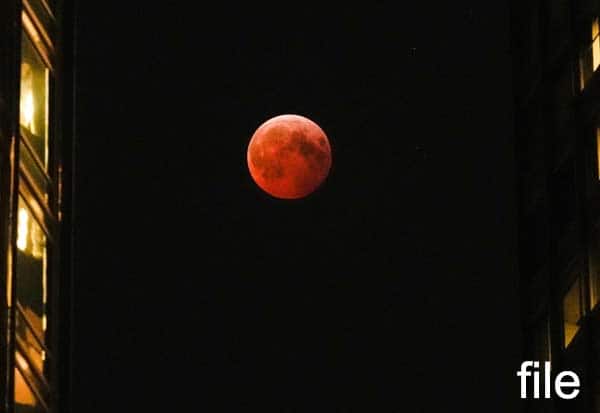
A total lunar eclipse—the first of the year—will occur on Tuesday (March 3), offering skywatchers a rare view of a blood-red Moon with a thin blue rim, according to Prabhakaran, district president of the Tamil Nadu Science Forum.
A lunar eclipse happens when the Sun, Earth and Moon align in a straight line and Earth’s shadow falls on the Moon. During totality, sunlight passing through Earth’s atmosphere bends, scattering blue light while red light reaches the Moon, making it appear dark orange or red—often called a “blood moon.”
This time, the Moon is expected to pass through the central shadow while grazing the upper edge of the umbra. As sunlight travels through higher layers of the atmosphere, including the ozone layer, yellow, orange and red wavelengths are absorbed, leaving a dark blue hue that can appear as a delicate line along the Moon’s edge.
The eclipse can be viewed safely with the naked eye, and binoculars or a telescope can help see details more clearly. It is expected to be fully visible in Assam, Arunachal Pradesh and Meghalaya, while cities including Delhi, Mumbai, Chennai, Bengaluru and Hyderabad may see only the final phase.
As per Indian time, the eclipse is expected from 4:58 pm to 5:32 pm, lasting about 58 minutes.