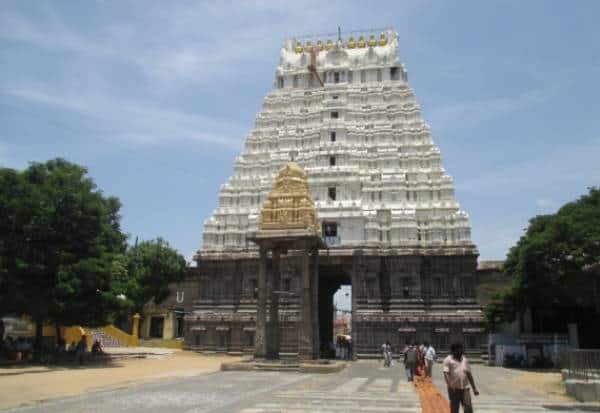
The Madras High Court has directed the state-level expert committee to constitute a sub-committee to examine whether the ongoing works for the kumbabishekam at Kanchipuram’s Sri Devaraja Swamy (Devaraja Perumal) Temple violate Agama rules.
The direction came on a petition filed by Krishna Devaraya from Karnataka, who alleged that the works were being carried out without approval from the Ancient Monuments authority and without adhering to Agama prescriptions. The matter was heard by Justice D. Bharatha Chakravarthy.
The petitioner’s counsel contended that changes such as increasing the wooden steps leading to the sanctum from six to ten, and lowering the ceiling to install a false ceiling while retaining a gold lizard feature on the roof, were contrary to Agama norms in a temple of archaeological importance.
Appearing for the Hindu Religious and Charitable Endowments (HR&CE) Department, Advocate General P.S. Raman said the works were undertaken after multiple meetings of a state-level expert committee that included the Archaeology Department head. He argued that a ramp was provided to ease access as the steps were steep, devotees were not barred from using the steps, and the ceiling modification was not against Agama rules; he also noted that about 90% of the work was complete and had been stalled for three months.
Observing that the temple has murals and is of heritage significance, the court said only Agama and archaeology experts can determine whether the works breach Agama rules. It ordered formation of a sub-committee comprising Agama and archaeology experts, mandating that a specialist in the Pancharatra Agama be included, with inspection dates to be announced at the temple and communicated to the petitioner. The sub-committee must consider objections and submit recommendations on which works may continue, which should not, and what can be modified, after which the state-level committee will issue directions based on the report.