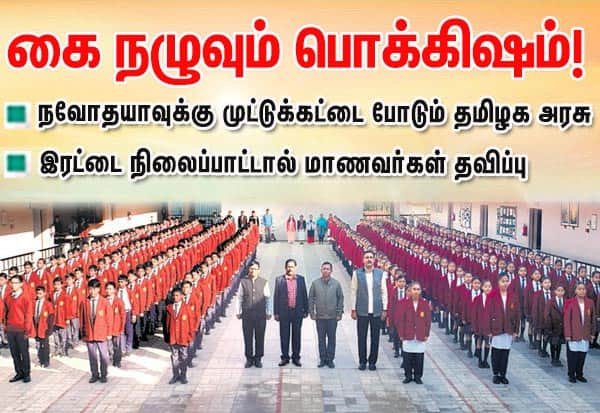
Coimbatore-based voices have accused the Tamil Nadu government of repeatedly obstructing the opening of Jawahar Navodaya Vidyalayas (JNVs), which are fully funded by the Union government. The state has cited the three-language policy, while projecting its own “model schools” as an alternative.
The model school scheme, launched in 2021–22 with 10 schools, has since been expanded across all 38 districts. Students are selected from government schools based on performance and achievements recorded on the EMIS platform, including NMMS scholarship qualifiers, class toppers, and those excelling in arts and sports.
However, questions have been raised about whether these schools match JNV standards in infrastructure and delivery. In several districts, including Tiruppur and Ramanathapuram, model schools reportedly function from rented buildings. In Coimbatore’s R.S. Puram, a special school for persons with disabilities was converted into a model school, where 275 students are currently studying.
The Coimbatore model school has reported strong outcomes over the past three years, including admissions to MBBS, veterinary medicine, and premier institutions such as NITs and IITs, with 39 students entering leading institutions through various entrance exams. At the same time, teacher groups allege that competitive-exam coaching relies on CBSE-based training despite the state syllabus, and that teachers are deputed from other government schools—affecting learning outcomes elsewhere.
Critics argue that most model schools do not admit students from Class 6, and in Coimbatore, Class 9 admissions began only this year. They say JNVs would offer a structured pathway from Class 6 to Class 12 with hostel, food and staff costs borne entirely by the Union government, requiring the state mainly to provide land. With mandated reservations—75% rural students, 33% girls, 15% SC and 7.5% ST—educationists have urged the state to reconsider its stance in the interest of rural and economically weaker students.