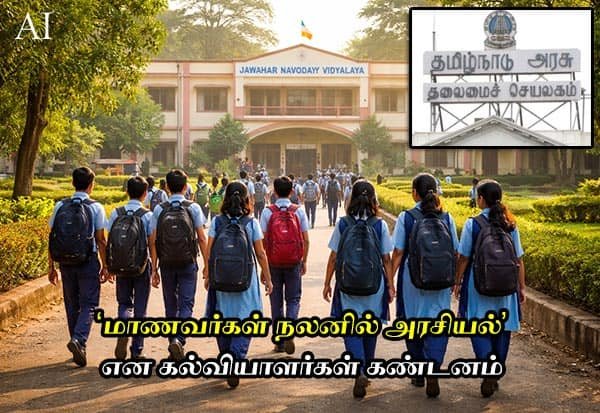
Tamil Nadu has reiterated before the Supreme Court that it will not permit Jawahar Navodaya Vidyalayas (JNVs) to be set up in the state, arguing that the residential schools are tied to a three-language framework while the state follows a two-language policy.
JNVs were launched nationwide under the Centre’s 1986 education policy to provide quality schooling for rural students, with one such residential school envisioned in each district. The medium of instruction is the mother tongue or state language up to Class 8, after which English and Hindi are used.
As per the scheme described, education is free for all students from Classes 6 to 8. From Class 9 to Plus Two, a monthly fee of Rs 600 is charged, with exemptions for girls, Scheduled Castes, Scheduled Tribes and students from below-poverty-line families. States are required to allot land, while the Centre bears infrastructure costs.
A petition seeking directions to the state to establish JNVs in every district was filed in the Supreme Court, following which the Tamil Nadu government recently submitted an affidavit stating that the schools cannot be allowed due to the language policy difference.
The affidavit and the state’s position drew sharp criticism from educators and BJP functionaries. They argued that multiple languages are already taught in Tamil Nadu and said the refusal would deny rural and poor students opportunities that are otherwise available to those who can afford private schooling.