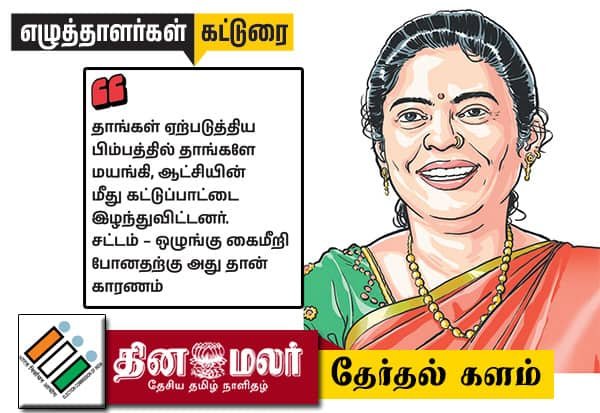
A PMK office-bearer has argued that Tamil Nadu’s electoral politics has moved away from welfare-driven public service and into what she calls “image politics”. She says the era when governance performance shaped a party’s reputation ended after the Kamaraj period.
In the article, she claims the DMK historically used emotional slogans to build political narratives and later relied on cinema, literature and stage platforms to reinforce them. She also alleges that instead of competing on welfare measures, personal attacks were used against MGR to weaken his public standing.
She further contends that the technology era has amplified such narrative-building through coordinated messaging across films, television, print and social media. According to her, dissenting voices were suppressed, and the ruling party eventually became overconfident in its own constructed image, leading to a loss of control over governance and law-and-order.
Turning to the coming election, she says the DMK’s key campaign pitch is projecting its alliance as “strong”. However, she argues that the number of parties in an alliance does not automatically translate into vote strength, and claims parties remain within the DMK-led front due to dependence and loss of distinct identity.
She concludes that the current DMK alliance is being projected as a show of strength to mask weakness, and alleges that new parties are sometimes encouraged indirectly before being absorbed into the alliance to inflate the perception of a “grand coalition”.