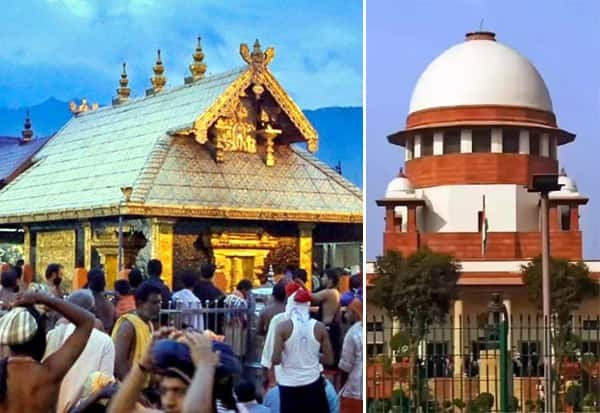
The Union government on Monday told the Supreme Court that the Sabarimala worship dispute involves matters of faith and long-standing religious practice, and therefore lies beyond the scope of judicial scrutiny.
The case concerns the Ayyappa temple at Sabarimala in Kerala’s Pathanamthitta district, where devotees traditionally observe a 48-day vow and undertake the pilgrimage with prescribed rituals. A long-followed practice permits entry for girls below 10 and women above 50, while restricting women in the 10–50 age group.
The practice was challenged as violating gender equality and religious freedom. In 2018, the Supreme Court allowed women of all ages to enter the temple. Review petitions were later filed, and in 2019 a five-judge Constitution Bench referred the matter to a nine-judge Bench.
Appearing for the Centre, Solicitor General Tushar Mehta argued that religious belief should not be tested on rational or scientific grounds and that courts need not intervene in matters rooted in faith and the autonomy of a religious denomination. He also cautioned against expanding the constitutional term “morality” into “constitutional morality”, calling it akin to a constitutional amendment.
After hearing submissions, the Bench directed parties to conclude arguments without seeking additional time and adjourned the next hearing to April 22.