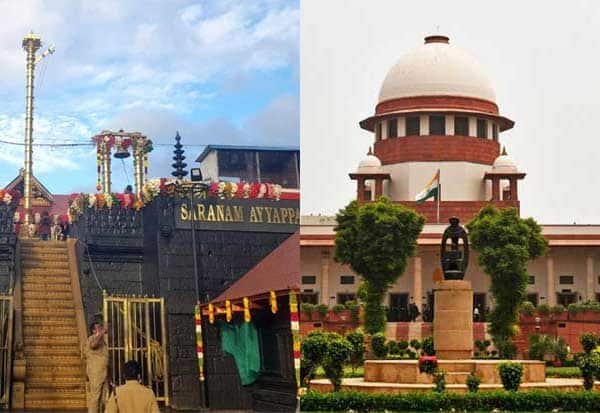
The Supreme Court on Wednesday saw sharp exchanges in the long-running Sabarimala case, with the Union government arguing that the temple’s practices should not be viewed through a “patriarchy” lens but as a distinct tradition.
A five-judge bench in 2018 had allowed women aged 10 to 50 to enter the Sabarimala Ayyappa temple in Kerala. Review petitions filed in 2019 were later referred by a five-judge bench led by then Chief Justice Ranjan Gogoi to a nine-judge Constitution Bench, which is also examining broader questions on religious freedom, including issues such as women’s entry in mosques and Parsi women’s rights.
During the third day of hearings, Justice B.V. Nagarathna questioned whether it was right to admit only a particular section while excluding others. She observed that places of worship and monasteries should provide worship rights to all, warning that discrimination could weaken Hinduism and create social divisions—an observation supported by Justice Aravind Kumar.
Responding for the Centre, Solicitor General Tushar Mehta said Sabarimala should not be treated as gender discrimination, citing the existence of temples where only women worship and other distinctive rituals. He argued that the rights of the devotee and the deity are inseparable and that religious practices must be assessed through deeply held beliefs rather than only “visible” legal rules.
Additional Solicitor General Vikramjit Banerjee urged the court to give weight to long-followed customs, while senior advocate C.S. Vaidyanathan contended that courts lack authority to alter temple traditions and that those who do not accept them may choose to stay away. The bench also raised concerns about when belief may warrant legal intervention if it affects others’ rights. The matter was adjourned to April 14 for further arguments from other sides.