
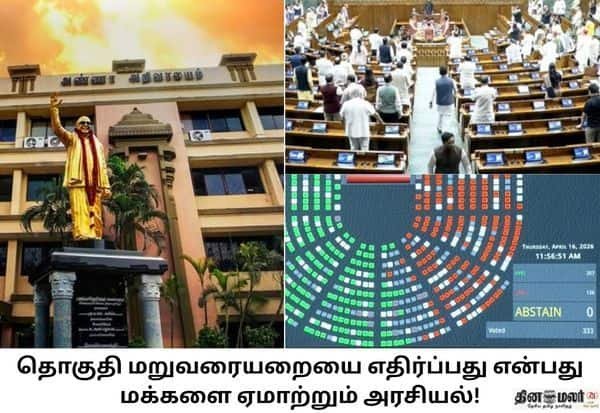
Even as Assembly elections are underway in five states, the issue of constituency delimitation has triggered a parallel political debate. DMK, Congress and a few other Opposition parties have voiced objections, while the BJP-led Centre has argued that the exercise brings more benefits than risks.
Delimitation is the democratic process of redrawing the boundaries—and in some cases the number—of Parliamentary and Assembly constituencies to reflect population changes. The stated objective is to ensure more equal representation by aligning constituencies so that voter strength is broadly comparable, reinforcing the principle of “one vote, one value”.
The report notes that the current exercise was expected to be linked to the 2021 Census, but the Census was not conducted due to the COVID-19 pandemic. As a result, the proposed delimitation is expected to rely on the 2011 Census. It also mentions a proposal to increase the total number of Lok Sabha seats from 543 to 850.
Historically, India set up its first Delimitation Commission in 1952 based on the first post-Independence Census. Subsequent commissions were formed in 1962, 1972 and 2002; the 2002 exercise altered constituency boundaries but did not increase the total number of MPs.
Among the benefits listed are more even voter distribution across constituencies, consideration of administrative and geographic factors such as district boundaries and natural features, and updated identification of SC/ST reserved seats based on population concentration. The article also argues that smaller, better-balanced constituencies can improve accessibility to elected representatives, ease administration, and help align funding and welfare delivery with population needs, including through mechanisms such as MPLADS.