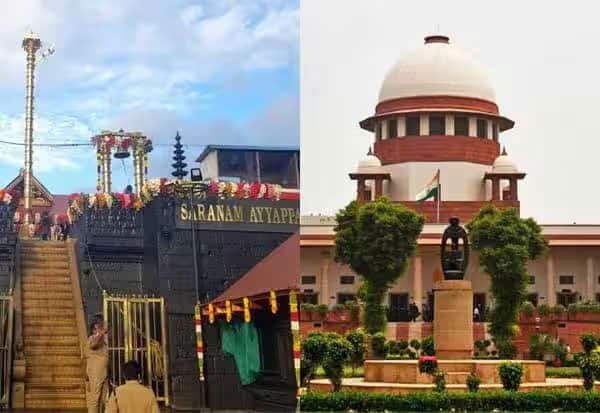
The Supreme Court, hearing the Sabarimala Ayyappa temple dispute, observed that it is extremely difficult—if not impossible—for courts to precisely define what constitutes an “essential” religious practice. The judges also cautioned that the State’s authority should not end up swallowing religious freedom.
A nine-judge Constitution Bench led by Chief Justice Suryakant is examining seven major legal questions linked to religious rights and freedoms, arising from petitions seeking entry for women of all ages into the Sabarimala temple. The hearing continued for the seventh day, with lawyers placing arguments on religion and social reform.
Senior advocate Gopal Subramanium argued that religious freedom is not a mere phrase but a conscience-based fundamental right, and warned that it should not be gradually eroded in the name of social reform. He said any law that intervenes in religious matters must face strict scrutiny, prompting the Bench to raise questions on the scope of “essential practices” and the limits of state interference.
Justice B.V. Nagarathna remarked that courts cannot determine what is essential to a religion. Justice Joymalya Bagchi also flagged issues around Article 25(2)(b), asking whether the State’s broader duties can be treated as “social reform” for the purpose of legislating in religious matters.
Senior advocates, including Aryama Sundaram, Rakesh Dwivedi and Mukul Rohatgi, argued that constitutional protections recognise distinct religious rights and that morality varies across faiths, making a uniform state-defined morality untenable. Concluding the day’s hearing, the Chief Justice said it is hard to lay down general guidelines on when the State may intervene in the name of reform, as it depends on the facts of each case, while reiterating that state power must not override religious freedom. The matter will be heard again tomorrow.