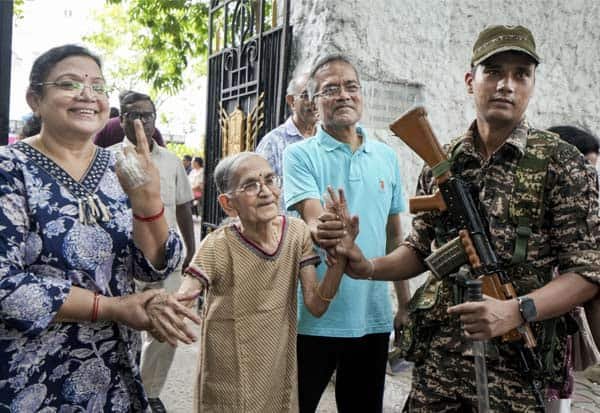
West Bengal’s Assembly election saw a very high turnout in its final phase, with the Election Commission reporting 92.47% polling as of 7:45 pm. The first phase had also recorded around 93%, drawing attention nationwide for what is being described as an unprecedented level of voter participation.
The state, which has a 294-member Assembly, voted in two phases—152 constituencies on April 23 and the remaining 142 constituencies in the last phase held on Tuesday. Chief Minister Mamata Banerjee’s Trinamool Congress (TMC) is seeking a fourth term, while the BJP is aiming to form the government for the first time, making it a direct contest.
Campaigning was sharply polarised, with TMC warning that a BJP government would restrict people’s food choices, while the BJP promised action against alleged Bangladeshi infiltrators, claiming it would remove obstacles to development. The election also drew heightened scrutiny as it followed an intensive revision of electoral rolls (SIR), which TMC had strongly opposed.
Despite strict controls and the deployment of 2,450 companies of central forces, clashes were reported in several places during the second phase. The BJP alleged that its candidate Priyanka was attacked by TMC booth agents at a polling station in Kolkata, while other BJP candidates reported attacks on supporters and vehicles in different areas. TMC, in turn, accused central forces of rough behaviour, including alleged baton-charging of women voters and children in Balta Belsinga village.
With turnout surpassing the earlier high of 84.72% recorded in the 2011 Assembly election, the scale of voting has raised questions about whether it signals an anti-incumbency wave. The outcome—especially in TMC’s perceived strongholds such as Kolkata, Howrah and South 24 Parganas—will be known on May 4.