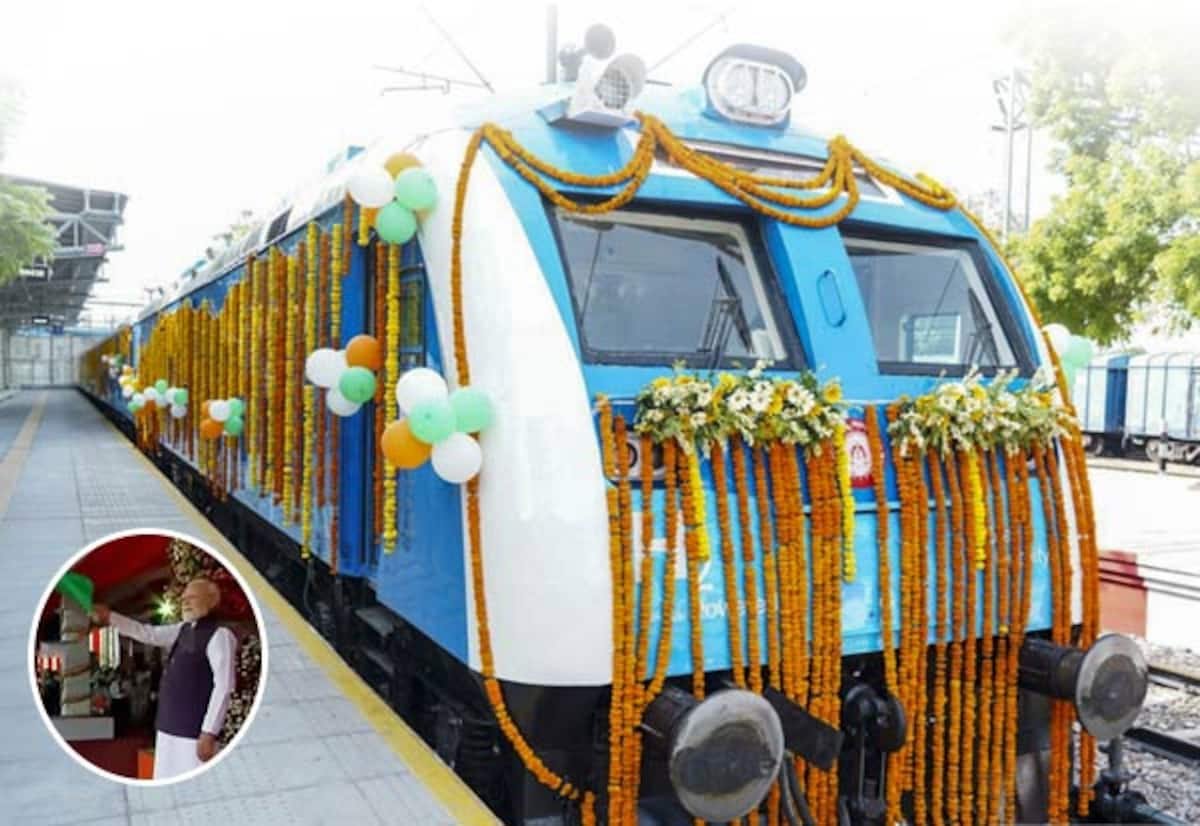
Prime Minister Narendra Modi on July 17 flagged off India’s first hydrogen train service in Haryana, marking the start of hydrogen-powered rail operations in the country.
The Railways had cleared the move to run hydrogen trains as an alternative to coal and diesel locomotives, with the stated aim of controlling carbon emissions. Following this, a modern hydrogen train was built domestically at the Integral Coach Factory (ICF) in Perambur, Chennai, at a cost of Rs 118 crore, and was handed over to the Railway Board in August last year.
Ahead of the launch, trial runs were conducted in Haryana, including on the Jind–Lalit Khera section. Under the supervision of a special team from the Research Designs and Standards Organisation (RDSO), Lucknow, a 10-coach hydrogen train was also successfully tested on the Jind–Sonipat route at a speed of 120 kmph.
Officials said the train can carry up to 2,600 passengers. The 10-coach hydrogen train is designed for an operating speed of 75 kmph.
The hydrogen train uses fuel cells instead of diesel, with clean water vapour as the primary emission, and is expected to reduce environmental impact while also lowering noise and vibrations compared to conventional trains. With this launch, India joins countries such as Germany, China and Japan in operating hydrogen trains.