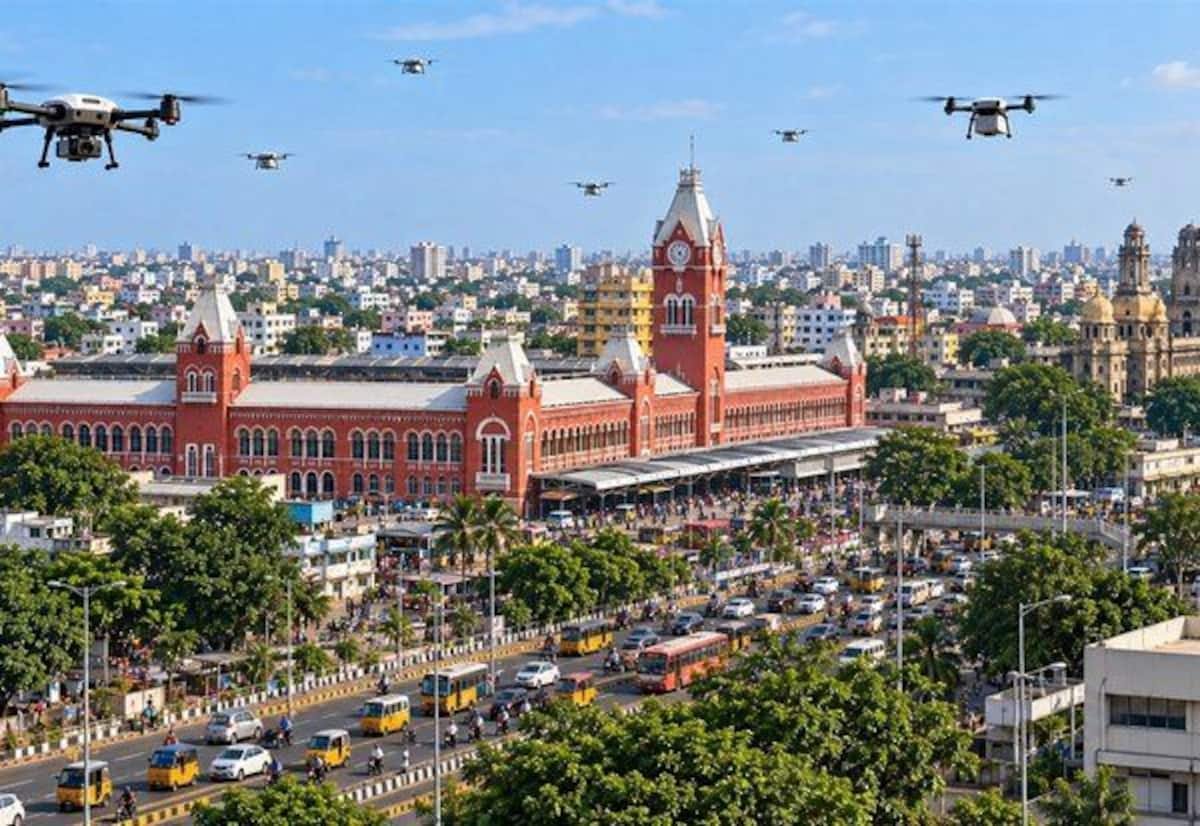
New Delhi: As the number of unmanned aerial vehicles (drones) operating over cities, farmlands and industrial zones grows, the Union government is planning a new national drone traffic control system to monitor and manage their movement.
Drones are increasingly used for tasks such as videography, land surveys and pesticide spraying. Trials are also underway in various places for commercial deliveries and even passenger-carrying drone concepts. The postal department has recently tested drone-based mail delivery from head offices to remote hill-village branch offices in Assam and Nagaland.
With expectations that low-altitude drone activity will expand further, the proposed system is being designed on the lines of conventional air traffic control, but focused on managing large numbers of small drones flying below 1,000 feet. The Airports Authority of India (AAI) has initiated consultations with global firms to understand the technology and operating models needed.
Experts have noted that relying only on the existing air traffic control framework could force drones to carry additional, heavier and costlier equipment, potentially affecting operations. AAI is therefore looking at a largely software-driven, automated platform that can track drones, enable real-time information exchange and issue alerts to operators when risks arise.
Officials said the new unmanned traffic management system will include three key safety features: ensuring drones stay within permitted zones with warnings near boundaries; enabling authorised users to view real-time location data of drones and regular aircraft in a given airspace; and preventing unauthorised drones from taking off. The government’s existing “Digital Sky” platform for drone regulation is also expected to be integrated with the new system.