
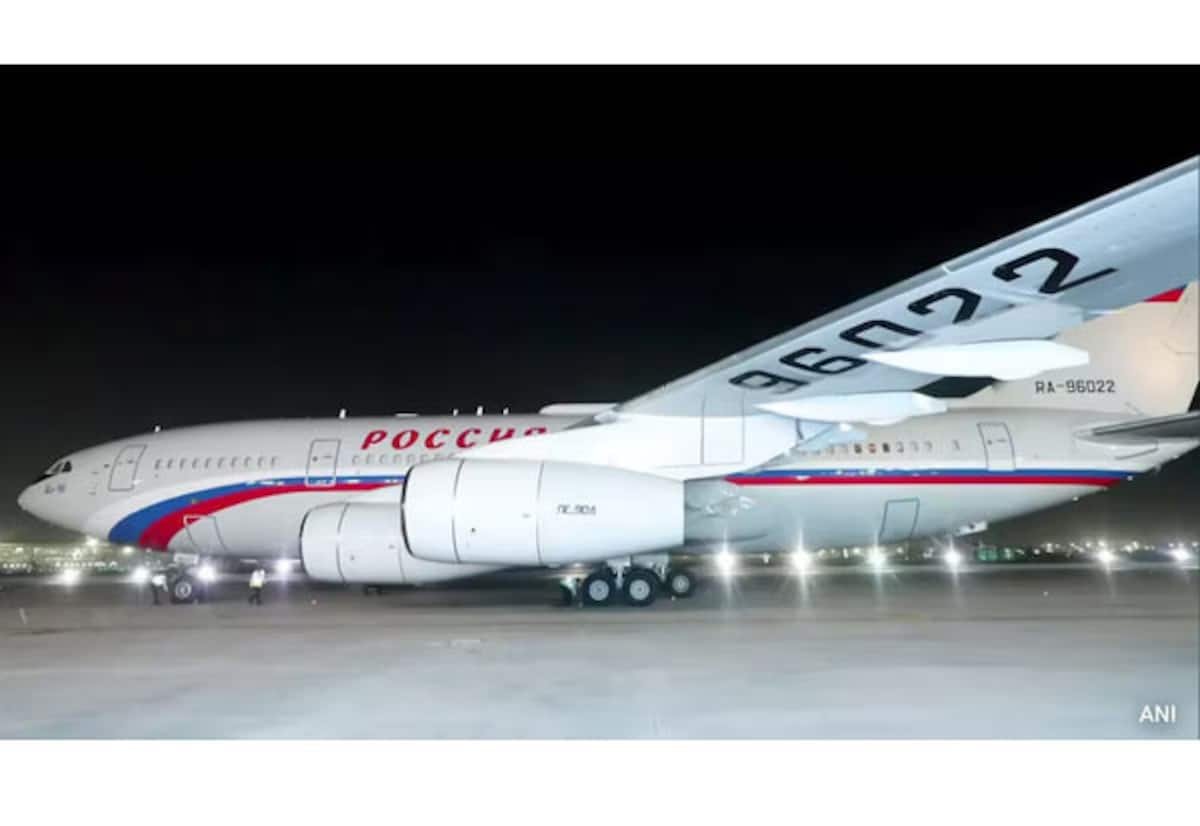
New Delhi: Russian President Vladimir Putin has arrived in Delhi to attend the BRICS summit, travelling on his special aircraft often referred to as the “Flying Kremlin”. Alongside the visit, his high-security limousine, the Aurus Senat, has also been transported to the capital as part of the security arrangements.
Putin has remained a leader who challenges Western countries for over 25 years and is considered a high-value target by multiple intelligence agencies. Russian authorities therefore place heavy emphasis on protective measures, including specialised security protocols for his aircraft and vehicles.
The Aurus Senat—sometimes described as a “fortress on wheels”—was developed under Russia’s state-backed Cortege project by Aurus Motors with partners including NAMI, Sollers JSC and UAE-based Tawazun Holding. The civilian version is priced at about ₹2.5 crore, while the presidential vehicle is equipped with military-grade protection.
Introduced in 2018 with design cues from the Soviet-era ZIS-110 limousine, the car is built for both performance and protection. It features a hybrid 4.4-litre twin-turbo V8 engine (598 hp, 880 Nm), a top speed of 160 kmph and can reach 100 kmph in about nine seconds.
The vehicle includes advanced braking systems and active cruise control, multi-layer bullet-resistant glass and thick steel plating designed to withstand explosions and gunfire. Its tyres are built to keep moving even after punctures or bursts, and it is fitted with secure communications and climate-adaptive luxury seating.
Putin also arrived with two similar Ilyushin aircraft, with only one carrying him—an approach intended to prevent adversaries from identifying his exact location. The aircraft type, developed in the 1980s, is designed to function as a command centre for the Russian President and to protect leadership even in extreme scenarios.
Powered by Aviadvigatel PS-90A turbofan engines, the plane can fly up to 11,000 km on a single refuelling. It is equipped to operate as a mobile command post during emergencies, with secure links to military, intelligence and government networks, along with radar-jamming technology and satellite-based communications for protected data transmission.