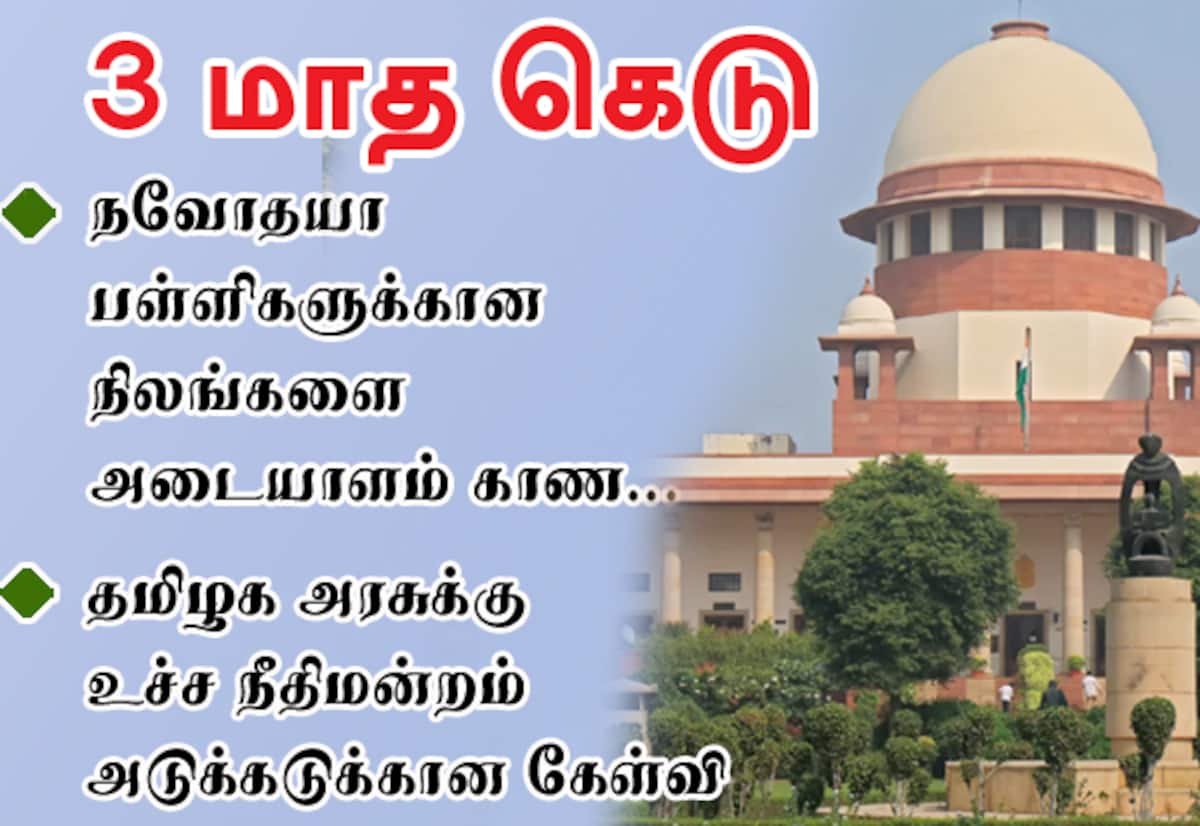
The Supreme Court has granted the Tamil Nadu government three months to identify land for setting up Jawahar Navodaya Vidyalayas (JNVs) across the state’s districts. The court questioned the state’s opposition and said the earlier direction to select sites cannot be withdrawn.
The case stems from a Madras High Court order that JNVs—funded by the Union government—should be established in every district in Tamil Nadu. Challenging that order, the state moved the Supreme Court, which had earlier sought an explanation on site selection within three weeks and asked why Tamil Nadu alone was keeping the scheme out.
Before a bench of Justices B.V. Nagarathna and Augustine George Masih, senior advocate Jaideep Gupta, appearing for Tamil Nadu, argued that the state follows a two-language policy while JNVs implement a three-language policy that includes Hindi. He said the issue involved the state’s policy-making powers and federal principles, added that the state provides better schooling, and contended that the scheme is not mandatory for states and could add to the state’s financial burden.
Justice Nagarathna observed that Hindi cannot be entirely avoided in Tamil Nadu and cautioned against a stance that could lead to resisting Union schemes more broadly. The bench said federalism must rest on mutual respect and cooperation, and noted that JNVs could serve as an additional strength alongside Tamil Nadu’s strong education system.
While clarifying that it was not directing immediate land acquisition, the court ordered the state to identify suitable land within three months and asked the Centre and Tamil Nadu to resolve differences through dialogue. The Union government had earlier assured the court that if the state provides land, other expenses would be borne by the Centre. The matter has been posted for further hearing on December 14.