
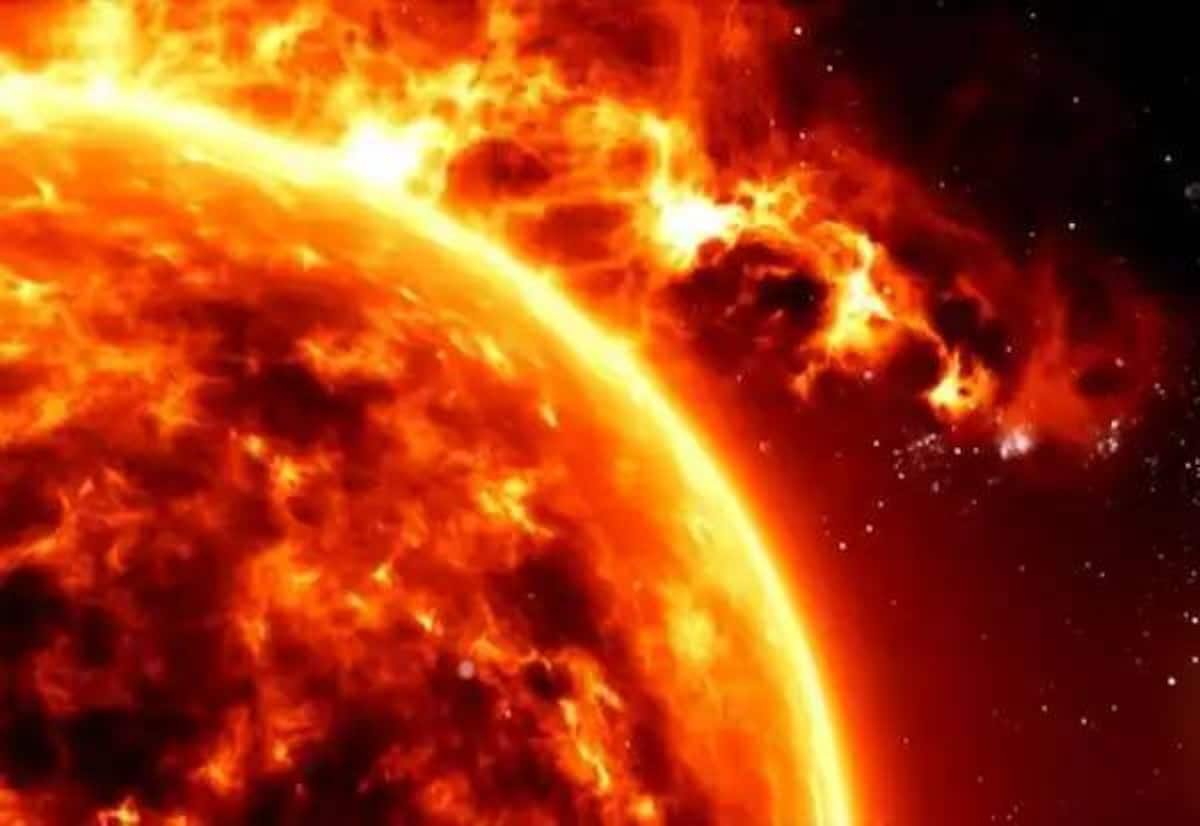
Two powerful eruptions from the Sun could disturb Earth’s magnetic field, with a solar storm impact expected around October 11, according to updates cited by the US National Oceanic and Atmospheric Administration (NOAA). The activity may also make auroras visible in some parts of the world.
NOAA has issued an alert for a moderate (G2) geomagnetic storm, noting that charged particles ejected from the Sun are moving toward Earth. The severity of any effects will depend on how the incoming solar material interacts with Earth’s magnetic field.
Such events are often linked to coronal mass ejections (CMEs)—large releases of magnetised plasma from the Sun. When these reach Earth, they can trigger geomagnetic storms. NOAA classifies geomagnetic storms from G1 to G5, with G1 being minor and G5 the most severe.
NOAA’s Space Weather Prediction Center said the eruptions from October 7 and 8 could combine as the faster second burst catches up with the first, potentially strengthening the disturbance. During a G2 storm, higher-latitude regions may see stronger effects, including voltage fluctuations in power systems, temporary changes for satellite operations, weaker radio signals and short-term variations in satellite navigation accuracy.
For India, the currently forecast G2 level is not expected to pose a major direct threat to daily life. Officials have not indicated that it implies nationwide power outages or a complete communications shutdown, and aurora sightings across India are not generally expected as they are more common closer to polar regions. NOAA noted the outlook remains a forecast and may change as new data arrives when the solar material nears Earth.